


Herringbone parquet. Image: Canva
Sustainable flooring solutions
We stand, walk, sit, lie, and live on them: floors define the impact, comfort, and indoor climate of a space, while also influencing a building project's environmental footprint and the well-being of its users.
They structure rooms, support usage concepts, and play a key role in architectural design through their materiality, color, and texture. At the same time, their role in sustainable construction is gaining focus, particularly regarding life-cycle aspects, material selection, emissions (e.g., VOCs), cleaning and maintenance, and the potential for material-specific deconstruction.
For the ecological assessment of a floor covering, both the choice of material and its actual service life are decisive. This is largely determined by maintenance requirements, cleaning intensity, repairability, and aesthetic acceptance. Even technically durable materials are often replaced prematurely, for instance due to changing usage requirements or design preferences. The replacement rate is therefore a central, often underestimated factor.
Floor coverings can be categorized according to various criteria, such as areas of application (residential, commercial, industrial), raw material origin, chemical composition, or surface texture. Furthermore, they are often grouped by product type, specifically resilient, textile, mineral, and wood-based coverings.
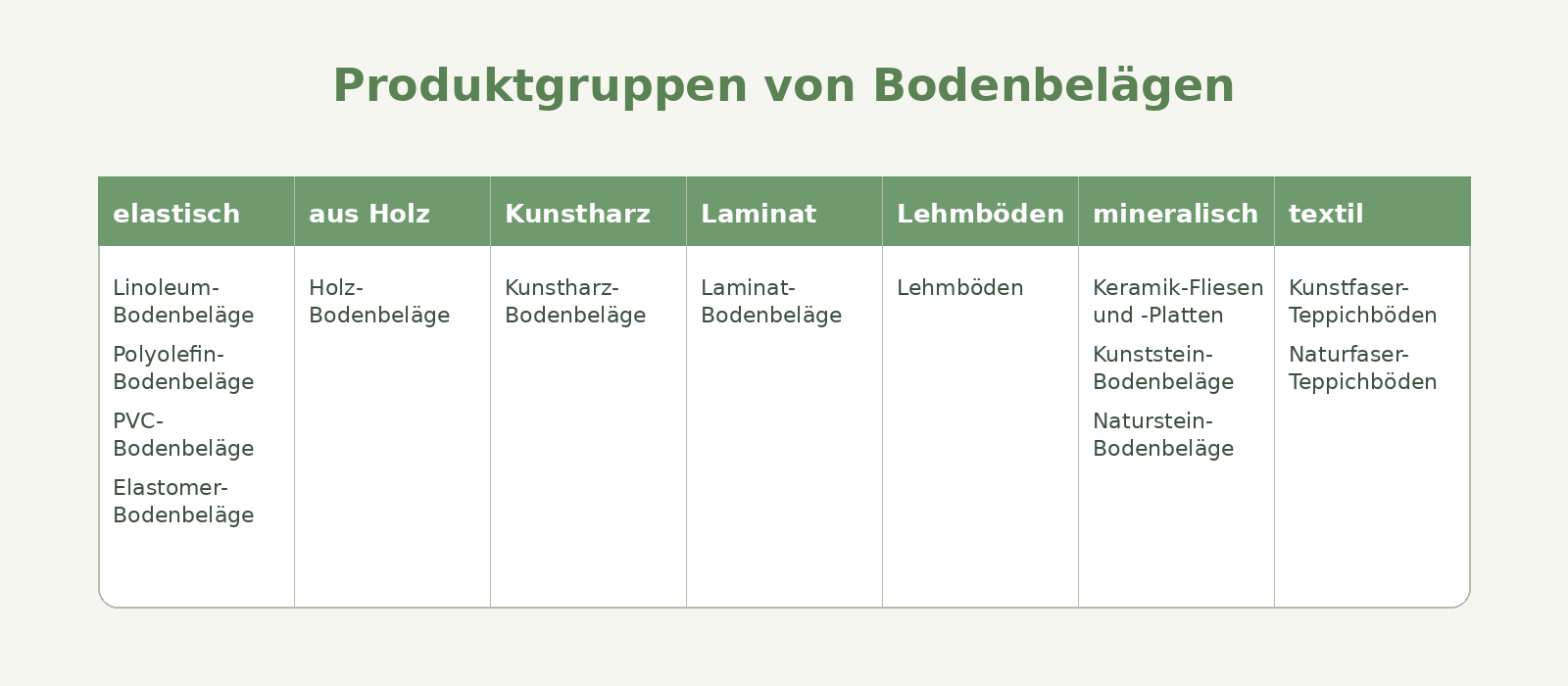
Historically, flooring solutions were closely tied to available materials and craftsmanship: wood planks, clay, natural stone, and ceramic tiles dominated depending on the use and the building task. These materials were characterized by durability, repairability, and often multi-generational usability. With industrialization and the increasing demand for standardized, cost-efficient solutions, the spectrum expanded to include industrially manufactured, often synthetic coverings such as PVC, laminate, or synthetic carpets, usually in multi-layered, glued system assemblies.
Today, it is well-established that floors contribute significantly to indoor air quality. Emissions from materials, adhesives, and surface treatments, as well as abrasion from use, can affect healthy living, especially in combination with underfloor heating. At the same time, glued and complex layered structures hinder material-specific deconstruction and circularity. Against this background, sustainable alternatives are moving into focus. The decisive factor here is not just the covering itself, but the entire assembly, from the installation method and the separability of the layers to the surface treatment.
A look at selected sustainable floor coverings and their respective properties shows the possibilities that arise from this.
Wood floors

Wood floors are among the most established flooring solutions and encompass a multitude of different constructions and formats. Fundamentally, a distinction can be made between plank floors and parquet. Wood planks consist of continuous boards made of hardwood or softwood and are mechanically fastened, for example by nailing or screwing. They represent a comparatively simple yet material-intensive construction method.
Parquet consists of smaller wood elements and is executed in various structures. A distinction is made between solid (single-layer) and multi-layer parquet. Single-layer parquet consists entirely of solid wood and includes strip parquet, mosaic parquet, and industrial parquet, among others. Hardwoods such as oak, beech, maple, or ash are predominantly used.
Multi-layer parquet consists of a wear layer of solid wood and underlying core and backing layers, which are made of either solid wood—usually softwood like spruce, pine, or larch—or wood-based materials. When using core layers made of wood-based materials such as plywood, MDF, or chipboard, it must be taken into account that formaldehyde can be emitted into the indoor air. Depending on the structure, two- or three-layer systems are used, the layers of which are generally bonded with synthetic resin-based adhesives.
The thickness of the wear layer determines the possibilities for refurbishment by sanding. While solid parquet can be refurbished multiple times due to its consistent material thickness, this is limited in multi-layer parquet by the restricted thickness of the wear layer. This is at least 2.5 mm, generally 3 to 4 mm for three-layer elements, and about 4 to 5 mm for two-layer strips. However, the actual service life depends not only on the construction but also on usage, maintenance, and the willingness to carry out repairs.
For both surface treatment and bonding, products that are as low-pollutant and low-emission as possible should be used. This applies equally to lacquers, oils, and waxes. The choice of surface affects not only emissions but also maintenance requirements, aging behavior, and repairability: oiled or waxed surfaces are generally easier to repair partially, while lacquered surfaces often offer higher protection but are more complex to refurbish if damaged.
Multi-layer parquet elements are often delivered with factory-applied surface treatments and used as pre-finished parquet, which allows potential VOC emissions to be tested on the ready-to-install product.
For ecological assessment, in addition to material composition, the adhesives, wood-based materials, and surface treatments used are particularly relevant. Equally decisive are the installation method and structural design, as they significantly influence the deconstructability and circularity of the floor assembly. The origin of the wood is also important, particularly with regard to sustainable forest management and transparent supply chains. Environmental labels that define requirements for sustainable wood sourcing offer guidance.
Clay floors

Clay floors are a type of mineral flooring solution used in various designs. They consist of earth-moist clay mixtures and are applied either as rammed earth floors or as clay fills within wooden sub-constructions.
Clay fills are installed as loose or lightly compacted layers between load-bearing wooden components and do not form a finished floor surface. The final floor structure is built up over the wooden sub-construction. This method is primarily used in wooden beam ceilings to add mass to the floor assembly.
Rammed earth floors are applied to a stable, shear-resistant substrate and mechanically compacted. Suitable substrates include concrete slabs, wooden structures, or sufficiently compacted soil layers. The thickness of the compacted clay layer is typically about 8 to 12 cm. Cracks that form during the drying process are filled with clay slurry. The surface is then mechanically finished, usually by sanding, and finally treated with wax or oil emulsions to increase durability and serviceability. The structural design can vary depending on requirements. Rammed earth floors can be combined with impact sound insulation, additional insulation layers, or underfloor heating systems. Due to their high thermal storage capacity, they can absorb heat and release it later, contributing to thermal comfort. Furthermore, clay has a high sorption capacity and can help stabilize and regulate the indoor climate. However, the effectiveness of this moisture-regulating property is significantly influenced by the chosen surface treatment. In terms of use and maintenance, clay floors are sufficiently durable and easy to repair. Local damage can be fixed by refinishing the surface or adding material. The surface is mineral-based and slightly textured, often used intentionally as a design element. Rammed earth floors can also be installed seamlessly over large areas. Polished rammed earth floors can visually resemble terrazzo, an effect that can be further influenced by the selection and composition of the aggregates.
Clay floors consist of natural mineral raw materials and are generally produced without chemically setting binders. As a result, the material remains water-soluble and can be dismantled, processed, and reused at the end of its service life or returned to the natural material cycle. It is also possible to use locally excavated material as a raw material.
Linoleum
Linoleum floors are resilient floor coverings consisting of a top layer based primarily on renewable raw materials, applied to a backing material, usually jute fabric. Depending on the product design, additional layers such as cork underlays, foam backings, or fiberboards may be integrated. The top layer is essentially composed of linseed oil, natural resins, wood or cork flour, and mineral fillers. The oxidative reaction of the linseed oil creates an elastic and durable material structure.
Linoleum offers good resistance to mechanical stress as well as to many everyday substances such as fats, oils, and weak acids. It is sensitive to highly alkaline media and, to a lesser extent, moisture. The material also does not exhibit significant electrostatic charging. To improve performance, linoleum flooring is usually surface-treated at the factory. Water-based or UV-curing coating systems are frequently used to increase durability and reduce maintenance requirements. Alternatively, the initial treatment can be applied after installation. In addition to emissions, the chosen surface treatment significantly influences cleaning requirements, performance, and the aging behavior of the flooring. When choosing coatings and adhesives, it is important to select low-emission products. From an ecological perspective, the high proportion of renewable raw materials is a key advantage. At the same time, it should be noted that linoleum is usually glued over the entire surface, which complicates dismantling and sorting, thereby limiting its recyclability. The actual service life is therefore determined not only by material quality but also by the installation method, care, and maintenance. A material-specific odor may occur at the beginning of use, which is due to reaction products of the linseed oil and fades over time.
Textile floor coverings made from natural fibers
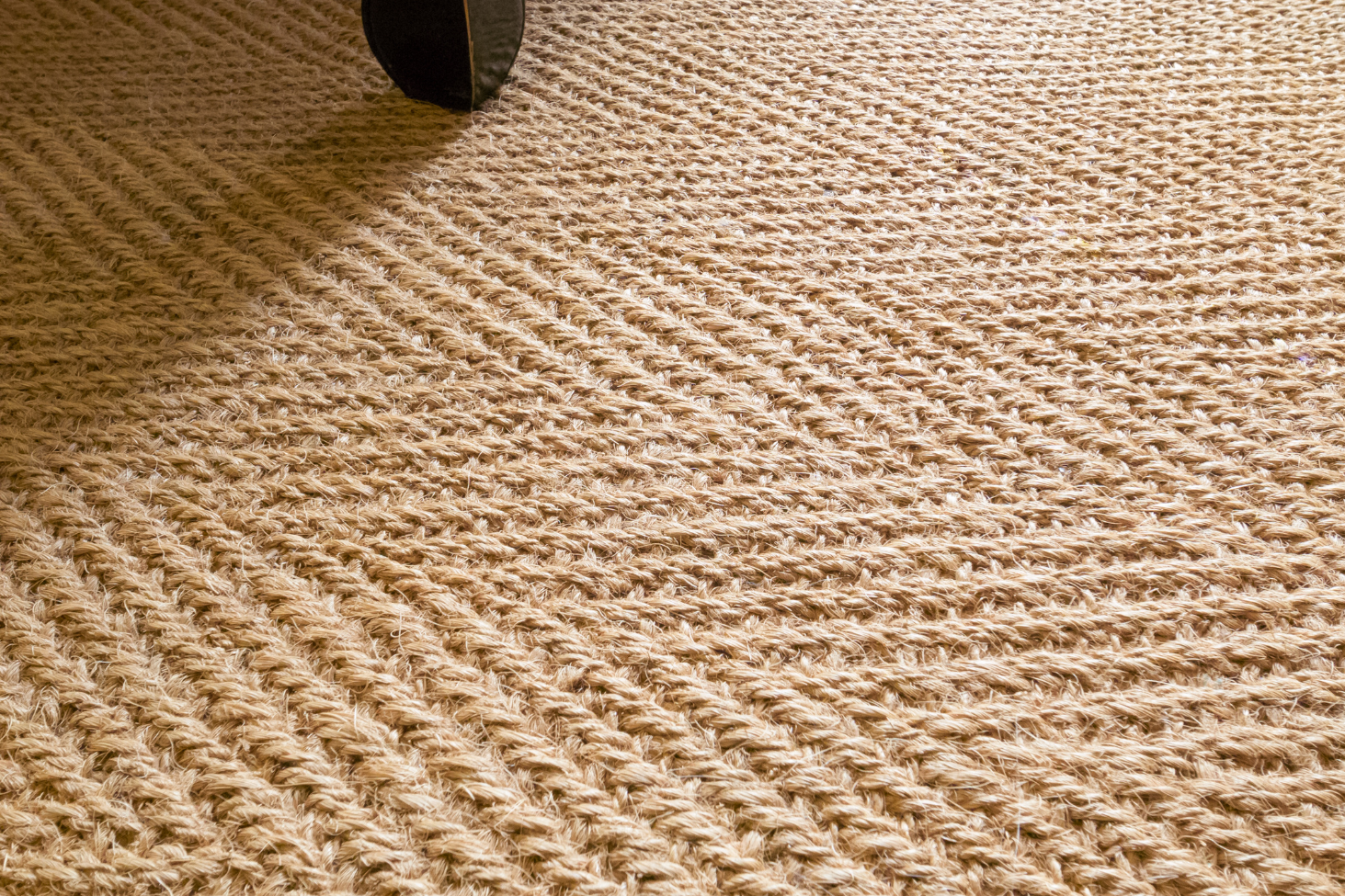
Textile floor coverings made from natural fibers consist of a wear layer made of plant or animal fibers. Materials used include new wool, sisal, coconut, and jute, as well as smaller amounts of seagrass, cotton, silk, or goat hair. The fibers are processed into yarn and then manufactured into woven or tufted floor coverings. The wear layer is usually integrated into a backing fabric, typically made of jute or cotton, and is often supplemented by a backing layer, for example, based on natural latex. Depending on the product, additional materials or treatments may be used to achieve specific technical properties.
Textile coverings made from natural fibers have good thermal and acoustic properties and are vapor-permeable. At the same time, they can absorb and release moisture, helping to regulate the indoor climate. The properties depend significantly on the type of fiber used. Sheep's wool, in particular, has the ability to absorb certain gaseous substances from the indoor air, including volatile organic compounds (VOCs), and bind them to a certain extent. Regarding usage, natural fiber coverings show varying levels of resistance. While materials like sisal or coconut can be used in high-traffic areas, softer fibers like wool are primarily suitable for residential areas. At the same time, textile coverings are sensitive to persistent moisture and dirt and require a comparatively high level of cleaning and maintenance. This affects not only their serviceability but also their actual service life and thus the ecological assessment of the flooring.
It should be noted that even floor coverings labeled as natural fiber, especially wool carpets, may contain a proportion of synthetic fibers. In addition, treatments such as mothproofing agents are sometimes used, which must be considered in terms of environmental and health aspects.
From an ecological perspective, natural fiber coverings are predominantly based on renewable raw materials, which can be harvested with relatively low energy consumption. At the same time, aspects such as water consumption, transport routes, and cultivation conditions must be considered. Additives, backing coatings, and adhesives can create material composites that limit recyclability. Regarding emissions, the selection of suitable installation and auxiliary materials is just as crucial as the flooring itself. Whenever possible, low-emission materials should be used, and alternative installation methods such as loose laying, tensioning, spot fixing, or modular systems should be preferred over full-surface gluing, as they facilitate dismantling and the replacement of individual sections.
Ceramic floor coverings
Ceramic floor coverings consist of fired mineral raw materials such as clay, kaolin, quartz, and feldspar and are used as tiles or slabs for both indoor and outdoor areas. Depending on the composition and firing process, a distinction is made between earthenware, stoneware, porcelain stoneware, cotto, and coarse ceramic products such as clinker. A key distinguishing criterion is water absorption, as it provides information about porosity and thus density, strength, and frost resistance.
While earthenware is primarily used indoors, stoneware and especially porcelain stoneware are characterized by high strength, low porosity, and frost resistance, making them suitable for high-traffic areas. Ceramic coverings are durable, mechanically resilient, and easy to clean. Surface properties can be specifically influenced by glazes or treatments, which affect cleaning, slip resistance, and performance. Installation requires material-appropriate adhesive and grouting systems, with special adhesives being used for dense coverings like porcelain stoneware.
The raw materials are predominantly extracted through open-pit mining, which impacts land use. Recultivation usually takes place after extraction. Production waste can sometimes be returned to the manufacturing process. Ceramic coverings can be used for decades. In practice, however, this potential is not always fully realized. Design trends and changing usage requirements mean that even robust and durable coverings are replaced prematurely. This brings issues of design longevity and long-term acceptance more to the fore. This is offset by the comparatively high energy consumption in the manufacturing process and transport costs due to the weight of the material. Furthermore, glued systems complicate dismantling and sorting, even though alternative solutions are increasingly being developed for this purpose.
New material-based manufacturing approaches
In view of the high CO₂ emissions of conventional ceramic tiles and the associated energy-intensive firing processes, alternative floor coverings are increasingly being developed that can be produced with significantly lower energy consumption. In addition to new manufacturing approaches, the focus is also shifting toward the use of secondary raw materials and mineral residues.
Some of these developments are based on natural formation processes. Inspired by mineral structures found in corals, for example, methods are used in which microorganisms trigger the formation of mineral bonds. Carbon and calcium are converted into stable compounds, binding loose particles together and solidifying them into a stone-like material.
Unlike traditional methods, the material is formed without firing or the use of conventional cement-based binders. The process takes place under ambient conditions, which significantly reduces energy consumption. The resulting materials achieve sufficient mechanical properties for use as flooring and can be integrated into existing applications.
This opens up new possibilities for architecture, particularly with regard to alternative manufacturing processes, the use of recycled materials, and a potentially improved carbon footprint compared to traditional ceramic flooring.
When viewed holistically across their entire life cycle, flooring made from renewable and mineral raw materials offers many advantages over chemical-synthetic alternatives in terms of climate protection, resource conservation, and healthy living. The interaction between material, structure, usage, and maintenance is crucial here.
Given the wide range of flooring options, individual requirements are just as relevant as technical criteria: How does a material feel? How much maintenance does it require? How does it change with use, and how are these changes perceived and accepted? Signs of wear can be seen as a loss of quality or as part of a desired aging process. Design durability also contributes to the long-term use of flooring.
Guidance for selecting sustainable flooring solutions is provided by the natureplus eco-label, which defines clear criteria for holistic sustainability, as well as the natureplus product database, which enables the targeted selection of suitable products.
Relevante Dateien & Links
https://www.wecobis.de/bauproduktgruppen/bodenbelaege-pg/bodenbelaege-holz-pg.html
https://www.oekologisch-bauen.info/baustoffe/bodenbelaege/parkett/
https://www.baunetzwissen.de/boden/fachwissen/_parkett/arten-von-parkett-151764
https://www.lehmtonerde.at/wp-content/uploads/2025/12/2025-09_Stampflehmboden.pdf
https://www.wecobis.de/en/bauproduktgruppen/bodenbelaege/lehmboeden-pg.html
https://www.wecobis.de/en/bauproduktgruppen/bodenbelaege/textile-bodenbelaege/naturfaser-teppichboeden.html
https://www.wecobis.de/en/bauproduktgruppen/bodenbelaege/bodenbelaege-aus-mineralischen-ausgangsstoffen/steingut-fliesen-und-platten.html
https://www.front-materials.com/mimmik/?utm_source=newsletter&utm_medium=email&utm_campaign=mimmik%20_tile&utm_content=photo
Relevante Dateien & Links
https://www.wecobis.de/bauproduktgruppen/bodenbelaege-pg/bodenbelaege-holz-pg.html
https://www.oekologisch-bauen.info/baustoffe/bodenbelaege/parkett/
https://www.baunetzwissen.de/boden/fachwissen/_parkett/arten-von-parkett-151764
https://www.lehmtonerde.at/wp-content/uploads/2025/12/2025-09_Stampflehmboden.pdf
https://www.wecobis.de/en/bauproduktgruppen/bodenbelaege/lehmboeden-pg.html
https://www.wecobis.de/en/bauproduktgruppen/bodenbelaege/textile-bodenbelaege/naturfaser-teppichboeden.html
https://www.wecobis.de/en/bauproduktgruppen/bodenbelaege/bodenbelaege-aus-mineralischen-ausgangsstoffen/steingut-fliesen-und-platten.html
https://www.front-materials.com/mimmik/?utm_source=newsletter&utm_medium=email&utm_campaign=mimmik%20_tile&utm_content=photo
Relevante Dateien & Links
https://www.wecobis.de/bauproduktgruppen/bodenbelaege-pg/bodenbelaege-holz-pg.html
https://www.oekologisch-bauen.info/baustoffe/bodenbelaege/parkett/
https://www.baunetzwissen.de/boden/fachwissen/_parkett/arten-von-parkett-151764
https://www.lehmtonerde.at/wp-content/uploads/2025/12/2025-09_Stampflehmboden.pdf
https://www.wecobis.de/en/bauproduktgruppen/bodenbelaege/lehmboeden-pg.html
https://www.wecobis.de/en/bauproduktgruppen/bodenbelaege/textile-bodenbelaege/naturfaser-teppichboeden.html
https://www.wecobis.de/en/bauproduktgruppen/bodenbelaege/bodenbelaege-aus-mineralischen-ausgangsstoffen/steingut-fliesen-und-platten.html
https://www.front-materials.com/mimmik/?utm_source=newsletter&utm_medium=email&utm_campaign=mimmik%20_tile&utm_content=photo
Relevante Dateien & Links
https://www.wecobis.de/bauproduktgruppen/bodenbelaege-pg/bodenbelaege-holz-pg.html
https://www.oekologisch-bauen.info/baustoffe/bodenbelaege/parkett/
https://www.baunetzwissen.de/boden/fachwissen/_parkett/arten-von-parkett-151764
https://www.lehmtonerde.at/wp-content/uploads/2025/12/2025-09_Stampflehmboden.pdf
https://www.wecobis.de/en/bauproduktgruppen/bodenbelaege/lehmboeden-pg.html
https://www.wecobis.de/en/bauproduktgruppen/bodenbelaege/textile-bodenbelaege/naturfaser-teppichboeden.html
https://www.wecobis.de/en/bauproduktgruppen/bodenbelaege/bodenbelaege-aus-mineralischen-ausgangsstoffen/steingut-fliesen-und-platten.html
https://www.front-materials.com/mimmik/?utm_source=newsletter&utm_medium=email&utm_campaign=mimmik%20_tile&utm_content=photo
Relevante Dateien & Links
https://www.wecobis.de/bauproduktgruppen/bodenbelaege-pg/bodenbelaege-holz-pg.html
https://www.oekologisch-bauen.info/baustoffe/bodenbelaege/parkett/
https://www.baunetzwissen.de/boden/fachwissen/_parkett/arten-von-parkett-151764
https://www.lehmtonerde.at/wp-content/uploads/2025/12/2025-09_Stampflehmboden.pdf
https://www.wecobis.de/en/bauproduktgruppen/bodenbelaege/lehmboeden-pg.html
https://www.wecobis.de/en/bauproduktgruppen/bodenbelaege/textile-bodenbelaege/naturfaser-teppichboeden.html
https://www.wecobis.de/en/bauproduktgruppen/bodenbelaege/bodenbelaege-aus-mineralischen-ausgangsstoffen/steingut-fliesen-und-platten.html
https://www.front-materials.com/mimmik/?utm_source=newsletter&utm_medium=email&utm_campaign=mimmik%20_tile&utm_content=photo
Relevante Dateien & Links
https://www.wecobis.de/bauproduktgruppen/bodenbelaege-pg/bodenbelaege-holz-pg.html
https://www.oekologisch-bauen.info/baustoffe/bodenbelaege/parkett/
https://www.baunetzwissen.de/boden/fachwissen/_parkett/arten-von-parkett-151764
https://www.lehmtonerde.at/wp-content/uploads/2025/12/2025-09_Stampflehmboden.pdf
https://www.wecobis.de/en/bauproduktgruppen/bodenbelaege/lehmboeden-pg.html
https://www.wecobis.de/en/bauproduktgruppen/bodenbelaege/textile-bodenbelaege/naturfaser-teppichboeden.html
https://www.wecobis.de/en/bauproduktgruppen/bodenbelaege/bodenbelaege-aus-mineralischen-ausgangsstoffen/steingut-fliesen-und-platten.html
https://www.front-materials.com/mimmik/?utm_source=newsletter&utm_medium=email&utm_campaign=mimmik%20_tile&utm_content=photo
Relevante Dateien & Links
https://www.wecobis.de/bauproduktgruppen/bodenbelaege-pg/bodenbelaege-holz-pg.html
https://www.oekologisch-bauen.info/baustoffe/bodenbelaege/parkett/
https://www.baunetzwissen.de/boden/fachwissen/_parkett/arten-von-parkett-151764
https://www.lehmtonerde.at/wp-content/uploads/2025/12/2025-09_Stampflehmboden.pdf
https://www.wecobis.de/en/bauproduktgruppen/bodenbelaege/lehmboeden-pg.html
https://www.wecobis.de/en/bauproduktgruppen/bodenbelaege/textile-bodenbelaege/naturfaser-teppichboeden.html
https://www.wecobis.de/en/bauproduktgruppen/bodenbelaege/bodenbelaege-aus-mineralischen-ausgangsstoffen/steingut-fliesen-und-platten.html
https://www.front-materials.com/mimmik/?utm_source=newsletter&utm_medium=email&utm_campaign=mimmik%20_tile&utm_content=photo
